Urea N46: Granular vs Prilled, a Buyer's Guide
SHORT ANSWER
Urea N46 is a nitrogen fertilizer containing at least 46 % nitrogen, made from natural gas via ammonia. It is sold in two physical forms with the same chemistry: granular urea (about 2 to 4 mm, hard, low dust, best for bulk handling, blending and mechanical spreading) and prilled urea (about 1 to 2.8 mm, softer, dissolves faster, common for hand application and solutions). Both trade under HS code 3102.10 and are priced per metric tonne against FOB Middle East and Egypt assessments and major import tenders. Buyers should specify nitrogen, biuret, moisture and size, and verify quality through independent inspection.
Key takeaways
- Both forms contain min 46 % nitrogen; the difference is particle size, hardness and handling, not nutrient content.
- Granular: 2 to 4 mm, harder, less dust and caking, ideal for bulk shipping, blending and spreaders. Usually priced at a premium.
- Prilled: 1 to 2.8 mm, softer, dissolves faster, suits hand application, solutions and some industrial uses.
- Key specs: nitrogen min 46 %, biuret max 1.0 %, moisture max 0.5 %, size range min 90 %.
- Priced per tonne against FOB Middle East / Egypt assessments (Argus, CRU, ICIS, Profercy) and tender results.
What is urea N46?
Urea, chemical formula CO(NH₂)₂, is the world's most widely used nitrogen fertilizer. "N46" refers to its nitrogen content: at least 46 % nitrogen by weight, the highest of any common solid nitrogen fertilizer. That high concentration keeps freight and handling cost per unit of nitrogen low, which is why urea is traded in very large volumes worldwide.
Urea is a petrochemical. Natural gas is converted into ammonia, and ammonia is reacted with carbon dioxide to make urea. Gas cost is the largest part of production cost, so urea supply and prices follow the natural gas market closely. The main exporting regions are the gas-rich Middle East (Qatar, Saudi Arabia, Oman, UAE), plus Egypt, Nigeria and Southeast Asia.
Granular vs prilled: the key differences
Granular and prilled urea have the same chemistry and nutrient value. What differs is how the final particles are formed:
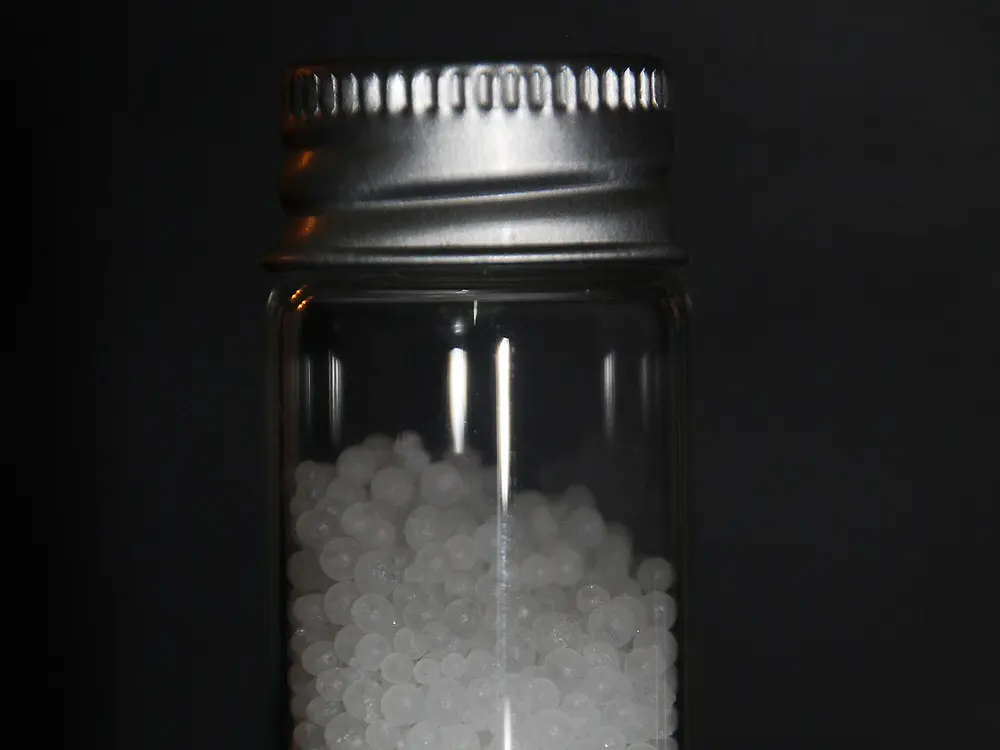
- Prilled urea is made by spraying molten urea from the top of a tall prilling tower. The droplets solidify as they fall, forming small, rounded prills.
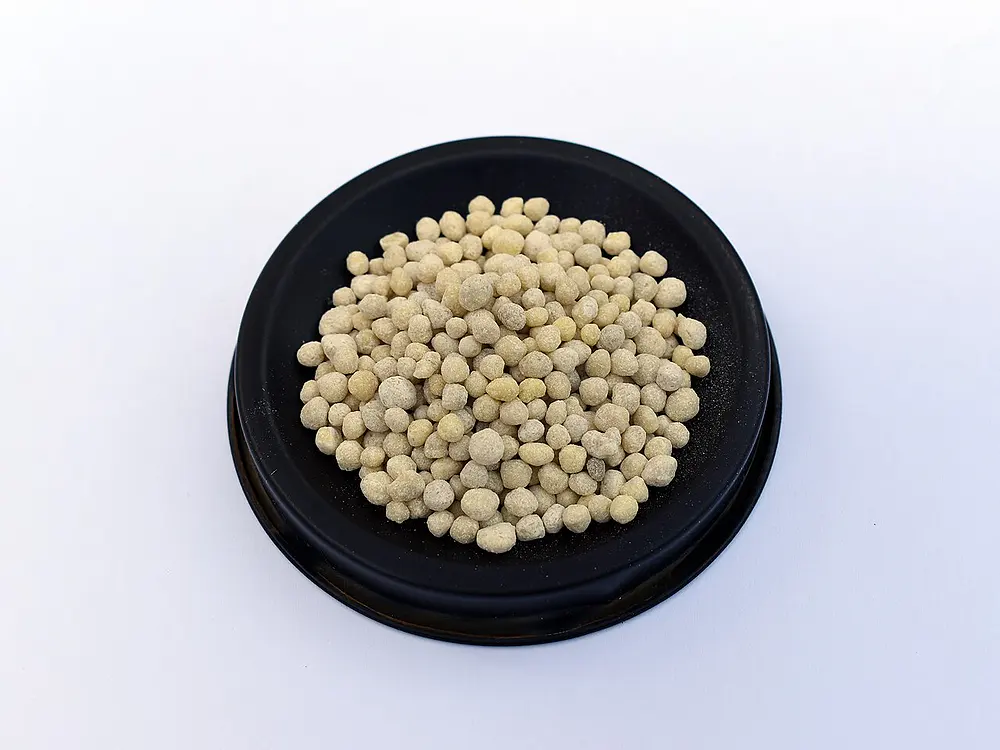
- Granular urea is made in a granulator, where urea is sprayed onto seed particles that grow layer by layer into larger, harder granules.
| Property | Granular urea | Prilled urea |
|---|---|---|
| Typical size | 2 to 4 mm | 1 to 2.8 mm |
| Hardness (crushing strength) | Higher | Lower |
| Dust and caking | Low | Higher |
| Bulk handling and long-distance shipping | Very good | Good, more breakage |
| Mechanical spreading width | Wider, more even | Narrower |
| Blending with DAP / MOP | Size-matched, low segregation | Can segregate in blends |
| Dissolving speed | Slower | Faster |
| Typical price | Premium | Discount |
Which one should you buy?
Choose granular urea if you:
- import in bulk vessels and store in warehouses for long periods;
- spread with mechanical or tractor-mounted spreaders;
- produce bulk-blended NPK fertilizers, where particle size must match DAP and potash to avoid separation.
Choose prilled urea if you:
- sell to smallholders who apply fertilizer by hand;
- dissolve urea for fertigation or foliar solutions, where faster dissolving helps;
- use urea in industry (resins, adhesives, animal feed supplements), subject to the required grade.
Note that AdBlue / DEF (diesel exhaust fluid) needs a separate technical-grade urea with very low biuret, aldehyde and impurity limits. Fertilizer-grade urea is not suitable for it. Tell us your end use and we will offer the right grade.
Specifications to put in your contract
| Parameter | Granular | Prilled |
|---|---|---|
| Total nitrogen | min 46.0 % | min 46.0 % |
| Biuret | max 1.0 % | max 1.0 % |
| Moisture | max 0.5 % | max 0.5 % |
| Size | 2 to 4 mm, min 90 % | 1 to 2.8 mm, min 90 % |
| Anti-caking treatment | Yes (typically urea-formaldehyde) | Yes |
| Appearance | White, free-flowing, free from foreign matter | White, free-flowing |
Biuret is a by-product formed when urea is overheated. High biuret can damage sensitive crops, so buyers for foliar use often ask for low-biuret urea (max 0.3 %).
See full details on our Urea N46 product page.
How urea is priced
Urea is priced per metric tonne, mainly against:
- Spot assessments for granular and prilled urea FOB Middle East and FOB Egypt, published weekly by price-reporting agencies such as Argus, CRU, ICIS and Profercy;
- CFR prices in major import markets such as Brazil and South Asia;
- Large import tenders, especially from India, which can move the global market.
Granular urea usually trades at a premium to prilled. Prices also move with natural gas costs and the planting seasons in major consuming regions. Elite Petro quotes on request for your quantity, form, packaging and Incoterm.
HS code, documents and packaging
Urea is generally classified under HS code 3102.10. Typical documents:
- Commercial invoice, packing list and bill of lading
- Certificate of origin
- Certificate of quality and weight from an independent inspector (SGS, Intertek or Bureau Veritas)
- Safety data sheet (SDS)
- Any import permit or fertilizer registration required by the destination country
Packaging options:
- Bulk vessel for large volumes (handysize to supramax)
- 50 kg PP woven bags with PE liner
- Jumbo bags of about 1 MT
Storage and handling tips
- Urea is hygroscopic: it absorbs moisture from humid air and can cake. Store it dry, covered and off the floor.
- Avoid stacking bags too high, which compacts the bottom layers.
- Keep urea away from incompatible materials, such as strong oxidisers and some acidic fertilizers, during storage and blending.
- Check the anti-caking treatment and moisture on arrival, especially after long voyages through humid regions.
Buyer checklist
- Specify granular or prilled, and the size range.
- Write nitrogen, biuret and moisture limits into the contract.
- State the end use (field, blending, foliar or industrial) so the right grade is offered.
- Agree the pricing basis, validity and Incoterm (FOB, CFR or CIF).
- Nominate an independent inspector for quality and weight at loading.
- Confirm origin and sanctions compliance.
- Use bank-to-bank payment instruments, such as a documentary letter of credit.
Red flags
- Offers far below current FOB Middle East levels, often with a "Russian origin" or vague origin.
- Requests for upfront fees, "soft probes" or proof of funds before any verifiable offer.
- Sellers who cannot name the producing plant or the loading port.
Read our anti-fraud guide before committing to any new supplier.
Summary
Granular and prilled urea N46 deliver the same 46 % nitrogen. Granular is harder, cleaner and better for bulk handling, blending and mechanical spreading; prilled is softer, dissolves faster and suits hand application and solutions. Choose the form that matches how the product will be shipped, stored and applied, write clear specifications into the contract, and verify every cargo with independent inspection.
About the author: The Elite Petro Trading Desk (Petroleum & Energy Division) at Elite Petro Trading & Facilitation works daily with buyers, suppliers, inspectors and banks across the energy, agriculture and metals markets. This article is general information, not legal or financial advice; always confirm specifications and regulations for your transaction.