Granular Sulphur: Specifications, Uses and How It Is Traded
SHORT ANSWER
Granular sulphur is elemental sulphur of at least 99.5 % purity, recovered from natural gas and crude oil at gas plants and refineries and formed into hard, uniform granules for safe bulk handling. Most of it is burned to make sulphuric acid, which is the key input for phosphate fertilizers. It is classified under HS code 2503.00, priced per metric tonne against Middle East producer prices and Argus, CRU or ICIS assessments, and shipped mainly in bulk carriers. Buyers should specify purity, ash, moisture, acidity and granule size, and verify quality through independent load-port inspection.
Key takeaways
- Standard commercial grade: min 99.5 % sulphur (dry basis); high-purity grades reach 99.9 %.
- Granules are formed from molten sulphur: they flow freely, create little dust and are safer to handle than crushed lump.
- The main use is sulphuric acid, mostly for phosphate fertilizers (DAP, MAP, SSP), followed by metal leaching and chemicals.
- HS code 2503.00. Priced per tonne, FOB Middle East or CFR destination, against producer prices and Argus / CRU / ICIS assessments.
- Ship in clean, dry, lime-washed holds and keep cargo dry: wet sulphur dust forms acid that corrodes steel.
What is granular sulphur?
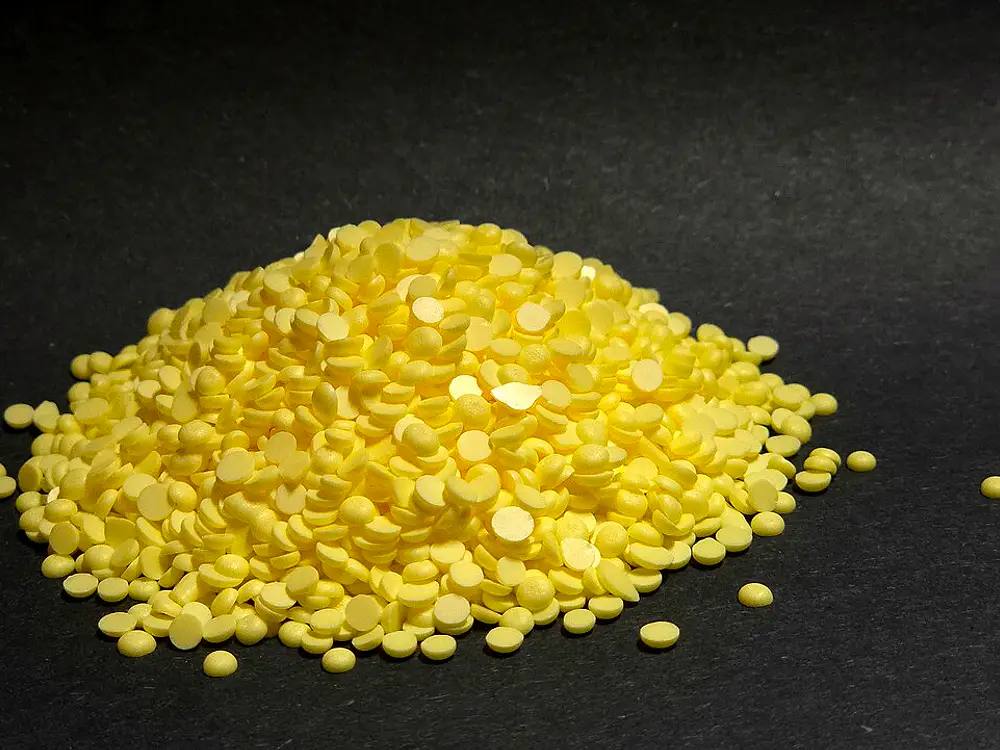
Granular sulphur is solid elemental sulphur (S) in the form of small, round, bright yellow granules, usually 2 to 6 mm in size. It is the standard way sulphur is traded internationally because granules are hard, uniform and free-flowing: they can be loaded, stored and reclaimed in bulk with far less dust than crushed lump sulphur.
Almost all sulphur traded today is a by-product of the oil and gas industry. Natural gas and crude oil contain sulphur compounds that must be removed to meet fuel and emission standards. Gas plants and refineries capture these compounds as hydrogen sulphide and convert them into liquid elemental sulphur, mainly using the Claus process. That molten sulphur is then solidified into a saleable shape.
How granules are made: formed vs lump sulphur
Liquid sulphur can be solidified in several ways. The shape matters because it decides how the product handles and ships.
| Form | How it is made | Handling |
|---|---|---|
| Granules | Molten sulphur sprayed onto seed particles in a rotating drum, building up layer by layer | Hard, round, low dust; the most widely traded form |
| Pastilles | Drops of molten sulphur solidified on a cooled steel belt | Uniform, flat-bottomed, low dust |
| Prills | Drops of molten sulphur cooled as they fall through air or water | Smaller and softer than granules |
| Lump | Large poured blocks broken up after solidifying | Irregular, dusty, more fire and handling risk |
Granules, pastilles and prills are together called formed sulphur. When buyers ask for "granular sulphur", they normally mean formed sulphur of uniform size with low dust and good strength.
Specifications to put in your contract
A typical specification for standard granular sulphur looks like this:
| Parameter | Typical limit |
|---|---|
| Sulphur purity (dry basis) | min 99.5 % (high-purity grade: min 99.9 %) |
| Ash | max 0.05 % |
| Moisture | max 0.5 % |
| Carbon (organic) | max 0.05 % |
| Acidity (as H₂SO₄) | max 0.02 % |
| Arsenic, selenium, tellurium | traces, limits as agreed |
| Granule size | 2 to 6 mm, min 90 % |
| Colour | bright yellow |
Why each matters:
- Purity and carbon affect sulphuric acid plant efficiency. Carbon (from hydrocarbons) darkens the sulphur and burns to unwanted by-products.
- Ash builds up in burners and filters.
- Acidity and moisture show how the cargo was stored. Wet sulphur generates acid, which corrodes equipment and ship holds.
- Arsenic and selenium matter to acid producers who supply food-grade or fertilizer markets with strict limits.
- Granule size and strength decide how much dust and fines form during handling. Many contracts also refer to the formed sulphur quality guidelines developed by the Sulphur Development Institute of Canada (SUDIC).
See the full specification sheet on our granular sulphur product page.
What granular sulphur is used for
- Sulphuric acid. By far the largest use. Sulphur is burned to sulphur dioxide, then converted to sulphuric acid.
- Phosphate fertilizers. Most of that sulphuric acid is used to dissolve phosphate rock and make phosphoric acid for DAP, MAP and SSP fertilizers. This is why sulphur demand follows the fertilizer market. See our DAP fertilizer page.
- Sulphur fertilizers. Sulphur-bentonite and sulphur-coated fertilizers correct sulphur deficiency in soils.
- Metal leaching. Copper, nickel and uranium mines use sulphuric acid to leach metal from ore.
- Industry. Rubber vulcanisation, detergents, dyes, pulp and paper, and many chemical processes.
Where it comes from
The Middle East is the world's largest exporting region, because its large gas processing and refining industries recover huge volumes of sulphur. Major exporting countries include the UAE, Saudi Arabia, Qatar, Kuwait and Oman, with Kazakhstan, Canada and the USA also significant. The largest importers are fertilizer and metals producers, especially in China, India, Morocco, Indonesia, Brazil and Africa.
Elite Petro supplies granular sulphur from established producers in non-sanctioned jurisdictions only, with full origin documentation.
How granular sulphur is priced
Sulphur is priced per metric tonne, usually on one of two bases:
- FOB Middle East, against the monthly prices published by the major Middle East producers, and
- CFR destination (for example China or India), against spot assessments published by price-reporting agencies such as Argus, CRU and ICIS.
Prices follow the fertilizer and metals markets closely and can move quickly, so offers are normally valid only for a short period. Elite Petro does not publish fixed prices; we quote on request for your quantity, destination and Incoterm.
HS code and documents
Granular sulphur is generally classified under HS code 2503.00 (sulphur of all kinds, other than sublimed, precipitated and colloidal sulphur). Final classification depends on the importing country's tariff schedule.
A typical document set includes:
- Commercial invoice and packing list
- Bill of lading
- Certificate of origin
- Certificate of quality and weight from an independent inspector (SGS, Intertek or Bureau Veritas)
- Safety data sheet (SDS)
- Cargo information required under the IMSBC Code for bulk shipments
Shipping and packaging
- Bulk vessels (handysize and supramax) carry most international volumes.
- Jumbo bags of about 1 MT and 25 or 50 kg bags suit smaller buyers and container shipments.
Bulk sulphur is shipped under the IMSBC Code (International Maritime Solid Bulk Cargoes Code). Formed sulphur is listed separately from crushed lump sulphur, which is regulated as a dangerous good. Whatever the form, the key precautions are the same:
- Load into clean, dry holds, usually lime-washed to protect the steel from acid.
- Keep the cargo dry. Wet sulphur and sulphur dust form sulphuric acid that corrodes steel.
- Control dust and ignition sources: sulphur dust can burn and, in confined spaces, explode.
We confirm the correct classification and documents for every shipment.
Buyer checklist
- Specify purity, ash, moisture, carbon, acidity and granule size in the contract.
- State whether you need standard (99.5 %) or high-purity (99.9 %) material.
- Agree the pricing basis (FOB or CFR, benchmark and validity) in writing.
- Nominate an independent inspector for quality and weight at loading.
- Confirm origin and sanctions compliance.
- Agree packaging, laycan and discharge terms.
- Use bank-to-bank payment instruments, such as a documentary letter of credit.
Red flags
- Prices far below current Middle East or CFR levels.
- Sellers who cannot name the producing plant or loading port.
- Requests for upfront "registration" or "allocation" fees.
- Refusal to allow independent inspection at loading.
Read more in our guide on how to avoid fraud in commodity trading.
Summary
Granular sulphur is a standardised by-product of oil and gas processing, sold at 99.5 % minimum purity in hard, low-dust granules. It feeds the sulphuric acid and phosphate fertilizer industries, is priced per tonne against Middle East producer prices and agency assessments, and ships mainly in bulk under the IMSBC Code. Buyers who write a precise specification, insist on independent inspection and keep the cargo dry can source it safely and reliably.
About the author: The Elite Petro Trading Desk (Petroleum & Energy Division) at Elite Petro Trading & Facilitation works daily with buyers, suppliers, inspectors and banks across the energy, agriculture and metals markets. This article is general information, not legal or financial advice; always confirm specifications and regulations for your transaction.